


Frequently asked questions
38 questions and short answers, grouped by system. Each section heading leads to the system page with its layer order and products.
Foundation and retaining wall waterproofing
Can waterproofing be applied from the negative side?
It is done when the building is already standing and there is no other option, but it does not replace positive-side waterproofing. Water keeps travelling inside the concrete and the reinforcement is not protected.
Can the primer be skipped?
It should not be. On absorbent concrete, waterproofing mortar applied without a primer loses its water to the substrate, cannot set and adhesion drops.
Why two thin coats instead of one thick one?
A single thick coat cracks at the surface and the continuity of the film is lost. Applied in two crosswise coats, the risk of pinholes disappears as well.
Can waterproofing be applied directly while water is running?
No. Running water washes the mortar out. The leak is stopped first with a plugging mortar, then the waterproofing is applied.
Terrace and roof waterproofing
Is waterproofing enough without a fall?
It is not. Waterproofing stops the water but does not prevent ponding. Standing water lifts the coating through freeze-thaw cycles and finds the smallest discontinuity. The fall must be at least 2%; otherwise a screed to falls is laid first.
Can a corner be turned without a cove?
It should not be. At a sharp 90-degree corner where the wall meets the slab the membrane is stretched and tears in time. A concave cove is formed at the corner with repair mortar and the waterproofing is carried over it.
Can it be applied over an old bituminous membrane?
Not directly. Polyurethane is incompatible with bitumen, and the bitumen can soften and migrate. The old membrane is removed, or a separating layer and a suitable primer are used, this situation should be put to the technical team.
Isn’t a single thick coat faster?
Faster but wrong. A single thick coat skins over on the surface, does not cure underneath and blisters. Two coats are applied crosswise; the second closes the pinholes of the first.
Wet area waterproofing
Aren’t tiles and grout watertight anyway?
They are not. Cement-based grout is absorbent and the void under the tile collects water. Tiling is a finish, not a waterproofing layer; the waterproofing must always be beneath the tile.
How far up the wall should the waterproofing go?
At least 180 cm in the shower area; 30 cm above floor level is enough on other walls. In permanently wet commercial areas it is taken up to the ceiling. The splash zone should not be underestimated.
Can it be done without corner tape?
It cannot. The wall-to-floor junction is the point of the structure that moves most, and the waterproofing becomes discontinuous there. The tape separates the movement from the waterproofing film.
How long after waterproofing can tiles be fixed?
Cement-based waterproofing must be allowed to cure fully; fixing early both reduces adhesion and traps moisture beneath the waterproofing. Follow the waiting time on the product’s technical data sheet.
Concrete repair and strengthening
Can mortar be applied without cleaning the reinforcement?
It cannot. If a layer of rust remains, corrosion continues under the mortar and within a few years pushes off the new mortar as well. The reinforcement is cleaned to bright metal and the back of the bar is exposed too.
Can the edge of the repair be left feathered?
It should not be. A thin edge taken down to zero cannot grip and lifts. The edge is cut square to a depth of at least 5 mm; the mortar bears against that step.
What happens if there is no curing?
The mortar loses its water early, shrinkage cracks form and the declared strength is not reached. Next to the cost of the material, curing is almost free insurance.
Is a thicker repair mortar stronger?
It can be the opposite. Thick filling mortars are usually lightweight and lower in strength; in structural repair you look at the class, not at the name. R4 is required on a load-bearing element.
Car park floor coating
Can the primer be applied without measuring surface moisture?
It should not be. If the moisture content of the concrete is above 4% by weight, a standard epoxy primer will not hold and the coating blisters within a few months. In that case the moisture-tolerant 405 ZNR 501 C is used.
Is acid washing enough instead of blasting?
It is not. Acid does not remove the laitance completely and leaves salts on the surface. An open-pored surface must be obtained by shot blasting or grinding; adhesion depends on it.
Is the system on ramps the same as on flat floors?
No. On ramps and turning areas braking and lateral forces are high; a broadcast anti-slip quartz is mandatory and consumption comes out close to the upper limit.
Is a UV topcoat needed in an enclosed car park?
It is not. On a surface that never sees the sun an aliphatic topcoat is an added cost. However, where the entrance ramp and the open edges receive daylight, it is applied to those areas.
Decorative flooring
When is the hardener broadcast?
After the bleed water has gone, but while the concrete is still workable. Broadcast too early, the material stays in the water and does not bond to the surface; too late, and the trowel cannot work the aggregate into the concrete. This window is a few hours at most and gets shorter as the air temperature rises.
Can curing be skipped?
No. The hardener enriches the top few millimetres of the concrete with aggregate; that layer needs water to gain strength. Without curing the surface loses water quickly, shrinkage cracks appear and the floor starts to dust. The cost of the curing material is the smallest item in the system; the price of skipping it is the whole surface.
Can stamped concrete be renewed years later?
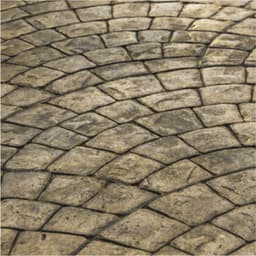
The pattern is permanent, the sealer is not. The 609 sealer dulls over time with wear and UV; when the surface is cleaned and the sealer renewed, the color largely comes back. The pattern itself is the shape of the concrete, so it is not lost.
Does the impregnation change the color of the surface?
ZNR SIGUARD and SOGUARD are declared as transparent and do not form a film; they penetrate the surface. Even so, a wet look can appear on absorbent natural stone. Test it in an unseen corner before moving on to a large area.
Facade thermal insulation, external insulation
Should the adhesive be spread over the whole board?
Full coverage on an even surface, ribbon and dab on an uneven one. Whichever is used, at least 40% of the board surface must be in contact; any less and wind suction pulls the board off.
Are anchors always needed?
On a new building it depends on the design and the wind load; in the refurbishment of an existing building it is in practice mandatory. Unless the adhesion of the old painted surface has been measured, the load must be carried by the anchors.
Where in the render does the reinforcing mesh go?
Not in the middle but close to the outer third, embedded while the first coat is wet. Left too close to the surface it shows; left too deep it does not hold the crack. A 10 cm lap at the joints is essential.
What is the difference between POLIBOND and CEOFIX BOND?
Their descriptions and consumption figures in the catalogue are identical; the only visible difference is color, POLIBOND is grey, CEOFIX BOND is white. Which to choose in which situation is not written on the product pages; this distinction should be clarified by the technical team.
Tile fixing and grouting
Is the trowel notch chosen according to tile size?
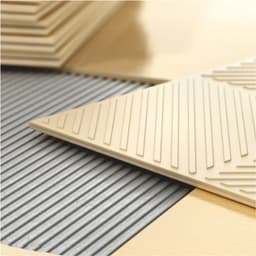
Yes. 6 mm for small tiles, 8-10 mm for medium sizes, 12 mm and above for large formats. As the notch grows, consumption increases almost linearly; between 6 mm and 12 mm the difference is more than double.
Is one-sided application enough for large tiles?
It is not. For tiles over 60 cm the adhesive is applied both to the substrate and to the back of the tile. The aim is contact without voids; a void underneath leads both to breakage and to water collecting in wet areas.
Can it be fixed over existing tiles?
It can, but class C2 is essential. Since the old surface is not absorbent there is no mechanical keying; adhesion is entirely chemical. The surface must also be cleared of grease and polishes.
Why does joint width matter?
The joint is the only place that absorbs the thermal and moisture-driven movement of the tiles. With zero joints the movement is taken by the tile itself and lifting starts at the edges. Joint width is set according to tile size.
Wooden and fiberglass boat coating Draft
This system description is a draft; the questions may change.
Why does a polyurethane topcoat go over the epoxy primer?
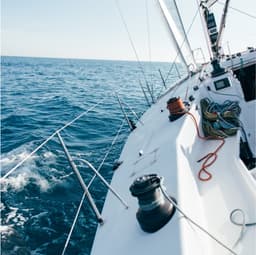
Epoxy is strong on adhesion and as a barrier, but it yellows and chalks under UV. Aliphatic polyurethane brings the UV resistance. The two work together: grip below, durability above.
How is the free-flowing or non-sag type of seam compound chosen?
According to the position of the surface. On a horizontal deck the self-leveling type (SL30) fills the joint from the bottom up; on the gunwale and sloping surfaces the non-sag type (MPU 25) stays in place. Both are polyurethane based and elastic.
Why must the fairing compound be light?
Fairing compound goes over the whole hull surface as a thin coat; a heavy compound adds serious weight in total. A low-density compound does the same job without the weight.
Is underwater coating part of this system?
It is not. This system covers above-water areas. The antifouling paint needed below the waterline is not in the ZNR catalogue; that item is bought from another supplier.
Primer selection Draft
This system description is a draft; the questions may change.
What happens if the primer is skipped?
On an absorbent surface the mortar loses its water, cannot set and adhesion drops. On a non-porous surface the coating does not grip at all. In both cases the failure appears weeks after application, as the coating lifts.
Can the same primer be used on every surface?
It should not be. Each primer is declared for different surfaces: ZNR P 200 for absorbent surfaces, ZNR P250 for fair-faced concrete, and ZNR P 300 for both non-porous and absorbent surfaces. A primer developed for an absorbent surface has no texture to grip on glossy tile. The choice depends not on the product but on the substrate beneath it.